

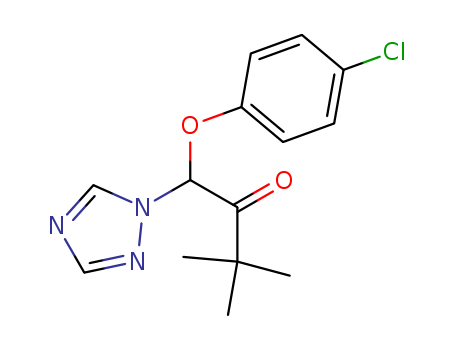
- Product Name Triadimefon
- cas 43121-43-3
- purity 99%

Agrochemicals
Buy high quality and low price Triadimefon 43121-43-3 now
- Molecular Formula: C14H16ClN3O2
- Molecular Weight: 293.753
- Appearance/Colour: Colorless to pale yellow crystalline solid with a slight odor
- Vapor Pressure: 5.26E-08mmHg at 25°C
- Melting Point: 82 °C
- Refractive Index: 1.579
- Boiling Point: 441.9 °C at 760 mmHg
- PKA: 1.41±0.11(Predicted)
- Flash Point: 221 °C
- PSA: 57.01000
- Density: 1.23 g/cm3
- LogP: 3.12430
Triadimefon(Cas 43121-43-3) Usage
|
Air & Water Reactions |
Insoluble in water. |
|
Reactivity Profile |
Triadimefon is incompatible with strong oxidizing agents and acids. Reacts with acid halides and anhydrides. Also reacts with most active hydrogen compounds . |
|
Fire Hazard |
Flash point data for Triadimefon are not available; however, Triadimefon is probably combustible. |
|
Trade name |
ACCOST?; ACIZOL?; AMIRAL?; BAY? 6681-F; BAYLETON?; BAY?-MEB-6447; BAYER? 6681-F; BAYER? MEB-6447; MEB 6447?; PRO-TEK?; ROFON? |
|
Pharmacology |
Triadimefon (36) and its alcohol analog triadimenol (37) have been intensively investigated to determine the influence of their enantiomeric difference on fungicidal activity. Between stereoisomeric triadimefon, no significant difference is observed in their fungicidal activity. However, triadimenol, which shows a much higher fungicidal activity than triadimefon, exhibits a clear stereochemistry-dependent activity difference. Greater fungicidal activity is possessed by the (1S, 2R)-isomer (28). |
|
Safety Profile |
Poison by ingestion. Mutation data reported. When heated to decomposition it emits very toxic fumes of Cland NOx. See also KETONES. |
|
Environmental Fate |
Soil. In a culture study, the microorganism Aspergillus niger degraded 32% of tri- adimefon to triadimenol after 5 days (Clark et al., 1978).Plant. In soils and plants, triadimefon degrades to triadimenol (Clark et al., 1978; Rouchaud et al., 1981). In barley plants, triadimefon was metabolized to triadimenol and p-chlorophenol (Rouchaud et al., 1981; Rouchaud, 1982). In the grains anPhotolytic. When triadimefon was subjected to UV light for one week, p-chlorophenol, 4-chlorophenyl methyl carbamate and a 1,2,4-triazole formed as products (Clark et al., 1978). |
|
Metabolic pathway |
Enzymic reduction of triadimefon is an important pathway in plants, soils and fungi and may be regarded as an activation process, which produces fungicidally active triadimenol. Two diastereoisomers of triadimenol, A and B [( 1RS,2SR)-l-(4-chlorophenoxy)-3,3-dimethyl-1-(1H-1,2,4-triazol-1-yl) butan-2-ol is referred to as diastereoisomer A; 1RS,2RS- is referred to as diastereoisomer β], are produced in different amounts by plants and fungi and the proportions may differ within the plant. Similar metabolic pathways are followed in mammals where reduction of the keto group yields triadimenol as the principal metabolite and oxidation of the butyl group gives alcohol and carboxylic acid derivatives. |
|
Degradation |
Triadimefon is stable to hydrolysis with a DT50 of more than 1 year at pH 3,6 and 9 (22 °C). On photolysis in methanol in borosilicate glass apparatus using a medium pressure mercury lamp, triadimefon undergoes cleavage of the C-1-N bond giving 1,2,4-triazole (2), 4-chlorophenyl methyl carbonate (3) and 4-chlorophenol(4) (Clark et al., 1978) (Scheme 1). Sensitised photolysis of triadimefon irradiated by light from a highpressure mercury lamp, with a Pyrex filter to exclude wavelengths below 290 nm, in the presence of fulvic acid and humic acid gave a variety of products. In water, the products formed were 4 and a dihydroxychlorobenzene (5). Although there are some ambiguities in the report concerning the allocation of structures to the compounds obtained, these included a dihydroxybenzaldehyde (6) and 5-chlorosalicylaldehyde (7). Major products in the presence of fulvic acid were 4 and a dihydroxychlorobenzene (5). In the presence of humic acid 4,5, a dihydroxybenzaldehyde (6) and 1-phenoxy-33-dimethyl-1- ( 1H-1,2,4-triazol-l- yl) -2-butanone (8) were formed (Moza et al., 1995). |
|
Toxicity evaluation |
Triadimefon inhibits the lanosterol demethylase, thereby interfering with ergosterol synthesis that is necessary for the integrity of fungal cell walls. This action confers specificity for fungi over vertebrates; however, by a similar mechanism triazoles have been reported to disrupt steroid and cholesterol metabolism in mammals. Perturbations of fatty acid, steroid, and xenobiotic metabolism pathways in liver through specific nuclear signaling pathways (constitutive androstane receptor (CAR) and pregnane X receptor (PXR)) have been suggested to contribute to the observed reproductive and hepatic toxicities. Triadimefon also both inhibits and induces specific hepatic cytochrome P-450 enzymes. A series of studies comparing triadimefon with other two conazoles (propiconazole and myclobutanil) have shown different modes of action in terms of carcinogenicity, hepatotoxicity, and developmental and reproductive toxicities. Studies in several species have shown that neurotoxicity is the endpoint of concern with both acute and repeated exposures to triadimefon and triadimenol. Triadimefon causes accumulation of synaptic dopamine, both in vivo and in vitro. Pharmacological challenges and neurochemical studies have shown that triadimefon blocks dopamine reuptake by binding to the dopamine transporter in a manner similar to other indirect dopamine agonists, such as cocaine and d-amphetamine. |
|
General Description |
Colorless to pale yellow crystalline solid with a slight odor. |
|
Agricultural Uses |
Fungicide: Triadimefon is a systemic fungicide that is used to control powdery mildews, rusts, and other fungi on coffee, seed grasses, cereals, fruits, grapes, vegetables, vines, pineapple, sugar cane, sugar beets, turf, shrubs, and trees. Not approved for use in EU countries. Registered for use in the U.S. U.S. Maximum Allowable Residue Levels for Triadimefon |
InChI:InChI=1/C14H16ClN3O2/c1-14(2,3)12(19)13(18-9-16-8-17-18)20-11-6-4-10(15)5-7-11/h4-9,13H,1-3H3
43121-43-3 Relevant articles
An Integrated Experimental and Computational Approach for Characterizing the Kinetics and Mechanism of Triadimefon?Racemization
Cheng, Qianyi,Teng, Quincy,Marchitti, Satori A.,Dillingham, Caleb M.,Kenneke, John F.
, p. 633 - 641 (2016)
Enantiomers of chiral molecules commonly...
Method for preparing trifloxystrobin by adopting microchannel reactor
-
Paragraph 0051-0057; 0065-0071, (2021/09/04)
The invention belongs to the technical f...
Methods and Compositions for Use in Glued-Wood Products
-
, (2022/01/04)
The present invention relates to biocide...
Preparation method of trifloxystrobin
-
Paragraph 0027-0037, (2020/07/12)
The invention discloses a preparation me...
AN IMPROVED PROCESS FOR THE PREPARATION OF TRIFLOXYSTROBIN
-
, (2019/04/10)
The present invention relates to an impr...
43121-43-3 Process route
-
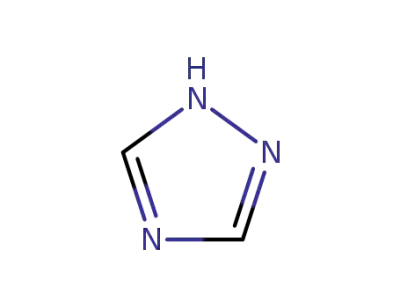
-
288-88-0
1,2,4-Triazole

-
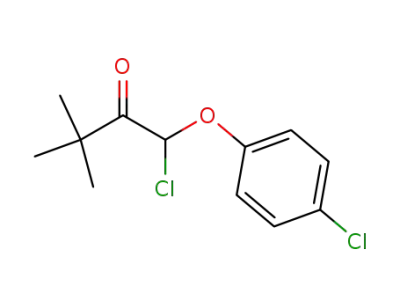
-
57000-78-9
1-(4-chlorophenoxy)-1-chloro-3,3-dimethyl-butan-2-one

-
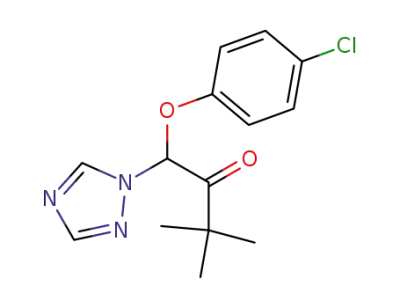
-
43121-43-3
1-(4-chlorophenoxy)-3,3-dimethyl-1-(1H-1,2,4-triazol-1-yl)butan-2-one
Conditions
| Conditions | Yield |
|---|---|
|
With
hydrogenchloride; sodium hydroxide; potassium carbonate;
In
water; acetone; toluene;
|
|
|
With
hydrogenchloride; sodium hydroxide; potassium carbonate;
In
water; acetone; toluene;
|
|
|
With
hydrogenchloride; sodium hydroxide; potassium carbonate;
In
water; acetone; toluene;
|
-
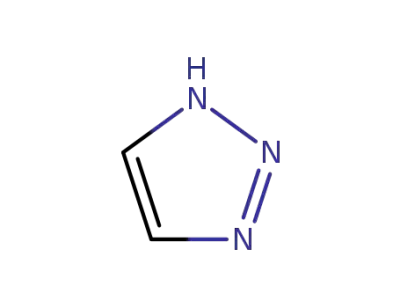
-
288-36-8
1,2,3-triazole
-
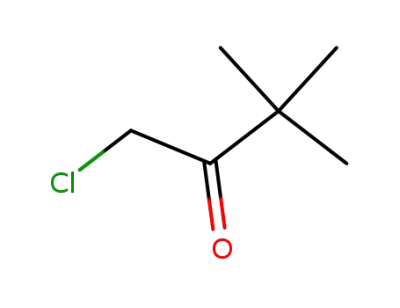
-
13547-70-1
1-chloro-3,3-dimethyl-butan-2-one
-
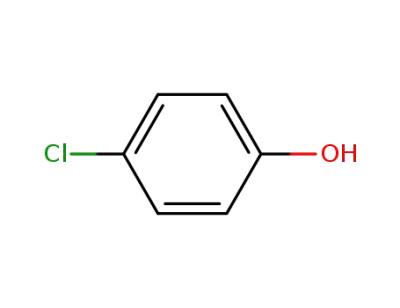
-
106-48-9,82344-39-6
4-chloro-phenol
-
-
43121-43-3
1-(4-chlorophenoxy)-3,3-dimethyl-1-(1H-1,2,4-triazol-1-yl)butan-2-one
Conditions
| Conditions | Yield |
|---|---|
|
1,2,3-triazole; 1-chloro-3,3-dimethyl-butan-2-one; 4-chloro-phenol;
With
potassium carbonate;
In
dichloromethane;
at 100 ℃;
for 4h;
With
sulfuryl dichloride;
In
dichloromethane;
at 50 ℃;
for 3h;
Temperature;
Solvent;
|
43121-43-3 Upstream products
-
118227-32-0
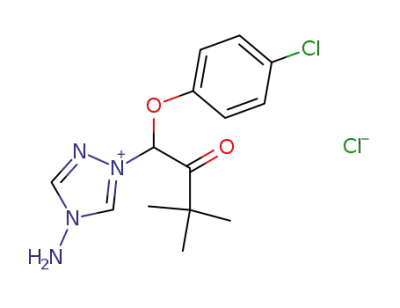
4-Amino-1-[1-(4-chloro-phenoxy)-3,3-dimethyl-2-oxo-butyl]-4H-[1,2,4]triazol-1-ium; chloride
-
288-88-0
1,2,4-Triazole
-
57000-78-9
1-(4-chlorophenoxy)-1-chloro-3,3-dimethyl-butan-2-one
-
73804-20-3
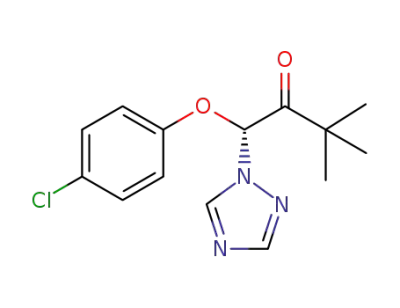
(R)-1-(4-chlorophenoxy)-3,3-dimethyl-1-(1H-1,2,4-triazol-1-yl)butan-2-one
43121-43-3 Downstream products
-
82200-72-4
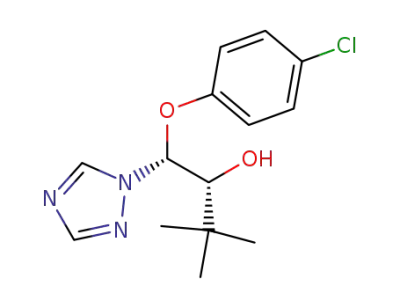
1-(4-chlorophenoxy)-3,3-dimethyl-1-(1,2,4-triazol-4-yl)butanol-2
-
89482-17-7
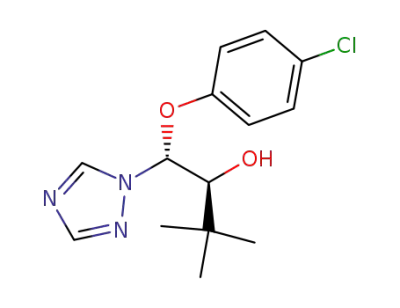
1-(4-chlorophenoxy)-3,3-dimethyl-1-(1,2,4-triazol-4-yl)butanol-2
-
55219-65-3
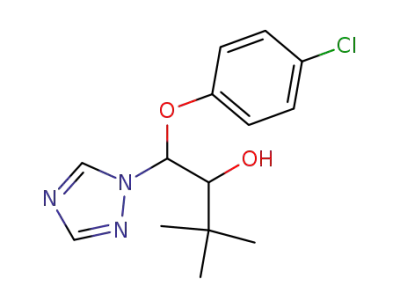
1-(4-chlorophenoxy)-3,3-dimethyl-1-(1H-1,2,4-triazol-1-yl)butan-2-ol
-
62843-29-2
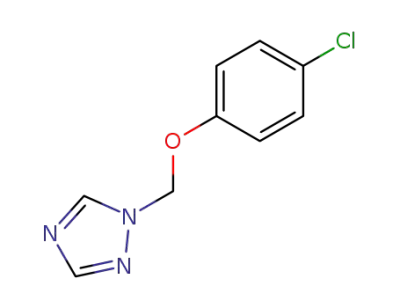
1-[(4-chlorophenoxy)methyl]-1,2,4-triazole
The order has been successfully placed. Our staff will contact you within 24 hours.